You're loaded and rolling westbound on I-580 through Altamont Pass, or pushing south on I-5 through Patterson, when something feels off. A gauge needle moves. A light flickers. The rig pulls differently than it did twenty miles ago. At that moment, every driver faces the same three-way decision: stop immediately, limp to the next safe exit, or keep running. Getting that call wrong costs more than the repair bill — it can mean a full rollover recovery, a catastrophic powertrain failure, or a roadside situation that blocks freight on one of California's busiest freight corridors. This guide walks through the three most consequential system failures a big rig driver will encounter — transmission, engine derate, and air brakes — and explains what the symptoms actually mean so you can make the right call before you need a wrecker.
Why the Stop-vs.-Limp Decision Matters on This Corridor
The stretch of road connecting Livermore to Tracy via I-580, then south on I-5 through Manteca and Patterson, is dense with grade changes, merge zones, and limited breakdown pull-outs. Altamont Pass sits at nearly 1,800 feet with long descents on both sides. Patterson Pass Road feeds agricultural traffic onto I-5 at Crows Landing with minimal shoulders. A big rig that loses braking performance, transmission function, or engine power on those grades is not just a recovery problem — it is an immediate safety event. Recognizing what your truck is telling you before that point is the entire game.
Transmission Warning Signs: What Your Rig Is Telling You
The transmission is the mechanical bridge between your engine and your drive axles. When it starts to fail, it almost always gives early notice — and almost every driver who ended up needing a big rig wrecker admits they noticed something a hundred miles earlier.
- Gear slipping or hunting: The engine revs climb but the truck doesn't respond with matching acceleration. This often points to internal wear or fluid breakdown rather than driver error.
- Rough or delayed shifts: Noticeable hesitation between gear changes, or a harsh clunk when the transmission finally engages, signals that internal components or fluid are no longer functioning correctly.
- Shaking through the cab during a shift: A properly functioning transmission shifts with very little vibration transferred to the frame. Shaking during gear changes is a warning that something is mechanically wrong.
- Burning smell from the drivetrain area: Overheating transmission fluid loses its lubricating properties, accelerating internal wear and increasing the risk of complete failure — especially under load on a grade.
- Reddish fluid puddle under the truck at a stop: Transmission fluid is typically reddish in color. A puddle underneath the drivetrain area is a leak that, if left unaddressed, leads to overheating and catastrophic failure.
- Loss of power under load: A truck that labors to accelerate on flat ground but ran normally yesterday has a developing problem that will be far worse on any grade.
The decision framework here is straightforward: a single symptom that appears and then resolves warrants immediate reporting to your fleet maintenance team and careful monitoring. Multiple concurrent symptoms — especially slipping combined with a smell or fluid leak — are a stop and call situation, not a limp-in situation. Continuing to operate a slipping transmission under load typically converts a repairable failure into a complete replacement.
Engine Derate Warnings: When Your ECU Is the One Telling You to Stop
Modern big rigs are equipped with engine control units that actively monitor emissions systems — including the DPF (Diesel Particulate Filter), DEF (Diesel Exhaust Fluid) system, and EGR (Exhaust Gas Recirculation). When any of those systems operate outside normal parameters, the ECU responds by deliberately reducing engine power. This is called a derate.
- Sudden loss of top-end speed or acceleration: The truck feels weak, will not accelerate past a certain point, or struggles on grades that were not a problem yesterday.
- Engine laboring under light loads: If the truck struggles on a flat highway with a load it should handle easily, the ECU may already be restricting power.
- Amber malfunction indicator lamps related to aftertreatment: Amber lights are advisory. They indicate a developing issue that needs service soon — not necessarily a stop-immediately situation, but not something to run for three more days either.
- Red STOP ENGINE light: This is not advisory. This light means the engine's control system has identified a condition severe enough to risk rapid, serious internal damage if operation continues.
- Countdown derate: Some engines issue a countdown — a limited number of engine starts or a mileage countdown — before enforcing a no-start condition. Reaching that countdown on the road is the worst possible place to find out.
A derate on Altamont Pass westbound — where grades demand full engine output and traffic merges at highway speed — can leave a fully loaded rig unable to maintain lane speed. That is a secondary-incident risk. The rule of thumb professionals follow: an amber derate light means get to a service location on your current shift. A red STOP ENGINE lamp means pull off at the next safe opportunity and do not restart the engine until a technician has assessed it.
Air Brake System Warnings: The Signs That Mean Stop Now
Unlike passenger car brakes, big rig air brake systems fail into a brakes-applied state by design — meaning a complete air loss will lock the brakes, not release them. That fail-safe protects against runaway, but it also means that air system problems can produce a different set of on-road symptoms that drivers sometimes misread as minor until they become catastrophic.
- Persistent hissing sound at rest or with brakes applied: A hissing noise indicates air escaping from somewhere in the system — a hose, fitting, tank, or brake chamber. Even a small leak compounds under load and on grades.
- Low air pressure warning light or buzzer activating: This warning activates when system pressure drops into a range where reliable braking cannot be guaranteed. It is not a nuisance alert — it is a stop-driving signal.
- Longer stopping distances or a soft brake pedal: When the truck requires more pedal input to slow down, or the pedal feels spongy compared to normal, the air supply or a valve is not performing correctly.
- Brake drag or heat after a descent: Smoke or extreme heat coming from a wheel end area after using the brakes on a grade indicates a brake that is dragging, sticking, or otherwise failing to release fully.
- ABS fault codes on the dash: ABS fault codes matter significantly on a loaded combination vehicle where stopping distances are already long without a fully functioning anti-lock system.
- Air pressure that does not build normally after startup: A system that cannot reach operating pressure on startup has a compressor or leak problem that will only worsen under operational load.
The critical difference between an air brake warning and most other system warnings: braking performance is the only thing standing between a loaded combination vehicle and a catastrophic loss of control on any grade. Descending Highway 132 into the Valley or coming down the east side of Altamont Pass on I-580 with a compromised air system is not a situation any driver should be in. If the low-pressure warning activates or you hear persistent hissing, the truck does not continue moving until the system is evaluated by a professional.
The Decision Matrix: Stop, Limp, or Keep Running?
Professional drivers and fleet managers use a simple three-tier framework when symptoms appear: Keep running (with immediate reporting): A single, mild symptom that does not affect drivability, does not involve braking performance, and has no associated warning lamps. Example: a slight roughness in shifting that appeared once and resolved. Report it at the next stop. Do not ignore it. Limp to the next safe exit: Multiple mild symptoms, an amber warning lamp, or a symptom that is worsening gradually but has not yet affected safety-critical systems. Know where you are. On I-5 between Tracy and Patterson, exits are spaced. On I-580 near Livermore, options are closer together. Get to the nearest location where the truck can be safely parked off the road and evaluated. Stop immediately: A red STOP ENGINE lamp, a low air pressure warning, visible smoke from a wheel end or drivetrain area, a brake that is dragging or locked, or any combination of symptoms that affects your ability to stop the vehicle. Pull off as far as possible from the travel lane and call for professional assistance. Do not attempt to limp further.
What Happens After You Call: Big Rig Recovery on This Corridor
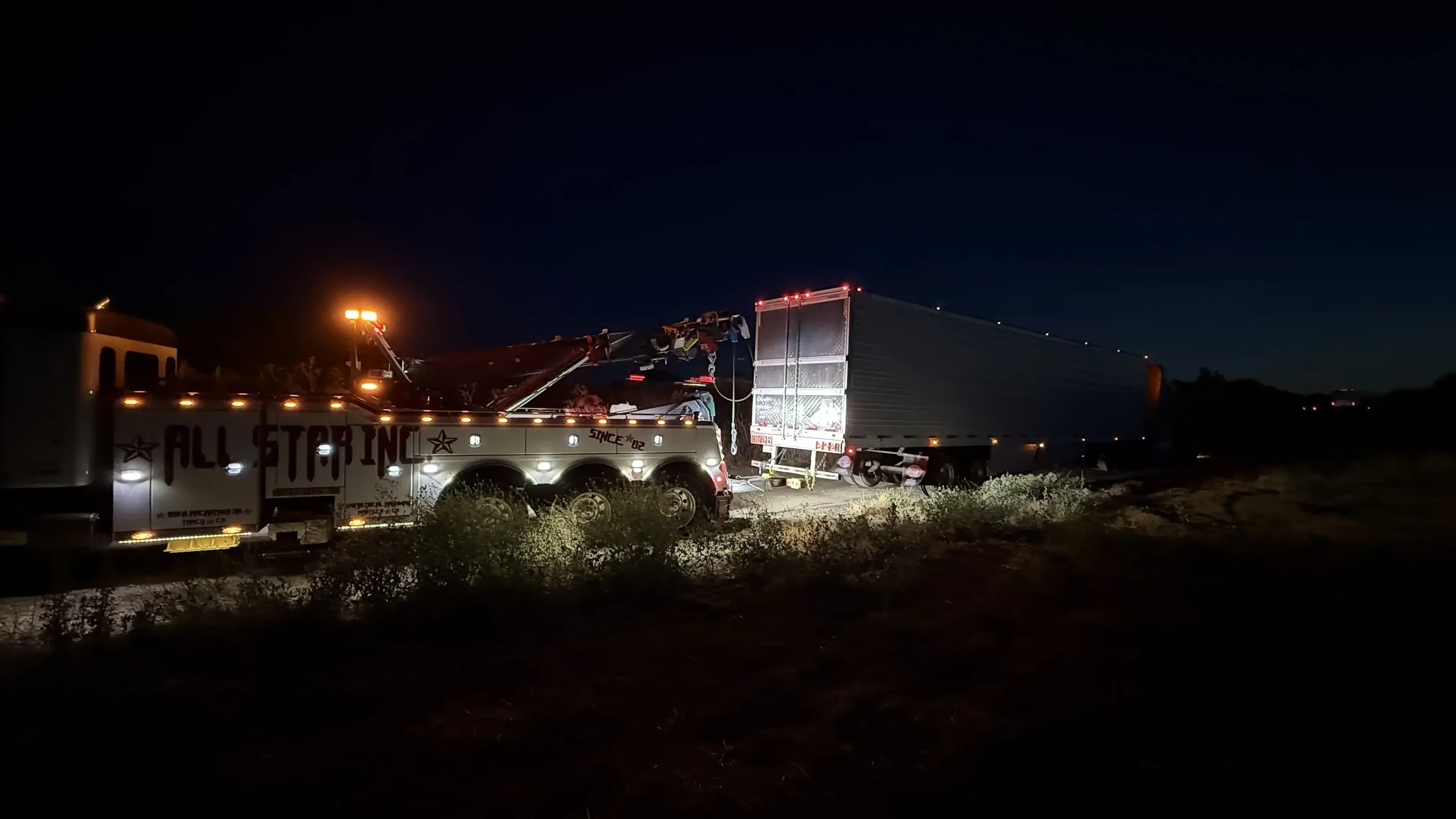
When a big rig goes down on I-580 at Altamont Pass, I-205 through Tracy, or I-5 south toward Crows Landing, the recovery operation is not a standard tow. Depending on load, position, and failure type, a professional heavy recovery team may need a rotator, a heavy wrecker, a Landoll transport, or a combination of equipment to safely move the unit without causing secondary damage to a drivetrain that may already be compromised. Fleet managers and dispatchers who have experienced this corridor know that the equipment staged matters as much as the response time. A wrecker that cannot handle the combination weight or the grade position of the breakdown only creates a second problem.
All Star Heavy Haul's big rig towing service →
All Star Heavy Haul & Towing operates 24/7 from yards in Tracy and Manteca with rotators, heavy wreckers, and Landoll transports specifically matched to the I-5, I-205, I-580, and Highway 99 freight corridor. Whether the unit is a loaded flatbed that detonated a transmission on the grade or a combination vehicle with an air system failure on I-680 near Pleasanton, the response comes from crews who run this corridor daily — not from a dispatch center routing a light-duty wrecker to a heavy-duty problem. For fleet managers looking to establish a preferred vendor relationship for breakdown coverage across this region, the commercial fleet towing program includes priority dispatch, direct-to-billing options, and pre-authorized response protocols that cut the time between a driver's call and equipment on-scene.
For Fleet Managers and Dispatchers: What to Have Ready Before the Call Comes
The worst time to figure out your heavy towing protocol is when a driver is standing on the shoulder of I-580 at midnight with a derating engine and a load that cannot be abandoned. Fleet managers and dispatchers who cover freight moving through the Tracy–Livermore–Patterson corridor should have answers to these questions before a breakdown happens: - Does your preferred towing provider have equipment rated for your heaviest combination vehicle? Gross vehicle weight, load type, and trailer configuration all affect which equipment can legally and safely move the unit. - Do your drivers know to call dispatch and the towing provider simultaneously, or sequentially? A communication gap of even 20 minutes on a busy freight corridor can mean secondary incidents. - Is your breakdown location data accurate? Drivers should be able to identify their milepost, direction of travel, and whether they are on the shoulder, median, or travel lane — not just the highway name. - Does your carrier agreement cover the full cost of a rotator or recovery operation, not just a standard tow? These are meaningfully different line items.