Disclaimer / Information Only Statement: The information in this article is provided for general informational and educational purposes only. It is not a substitute for professional mechanical diagnosis, driver training, legal advice, or OEM service guidance. Readers are responsible for evaluating their own circumstances, following company policies, manufacturer recommendations, and all applicable laws and regulations. By using this information, readers acknowledge that All Star Heavy Haul & Towing is not responsible for decisions made based on this content or for any loss, damage, or interruption arising from reliance on it.
You're parked on the right shoulder of I-5 south of Tracy, your drive axle buried in soft shoulder fill, trailer fully loaded. You call for help and the dispatcher asks you a question you weren't expecting: "Is the truck stuck, or is there mechanical damage?" That single question is the fork in the road between a winch-out and a full recovery — two very different operations that require different equipment, different crew sizes, and different amounts of time to complete safely. Understanding what each one actually involves helps you give dispatchers better information, helps fleet managers set realistic expectations, and helps owner-operators understand why the truck that shows up may look very different from one call to the next.
Towing vs. Recovery: They Are Not the Same Thing
This distinction trips up a lot of drivers and dispatchers, and it matters more on a big rig call than anywhere else. At the core level, towing means transporting a vehicle that is already on its wheels and in a position where it can be moved. Recovery is the process of getting a vehicle into a towable position first. A big rig with a blown steer tire sitting upright on the shoulder needs a tow. A big rig that has slid off the road and is resting in a drainage ditch at a 30-degree lean may need recovery before it can be towed anywhere. The two services often happen back-to-back on the same call — but they require separate planning, separate rigging, and sometimes separate pieces of equipment.
What a Big Rig Winch-Out Actually Involves
A winch-out is the right call when the vehicle is physically stuck but mechanically intact. The rig can operate under its own power once it is back on stable ground — the problem is purely positional. This is common along the I-5 corridor between Tracy and Patterson, where soft shoulders and irrigation-adjacent grades create conditions where a truck can sink several inches in seconds. It is also common on Altamont Pass (I-580) after heavy rain softens the soil on the shoulder cuts, and on Highway 132 east of Livermore where the pavement transitions from standard shoulder to graded fill.
The defining characteristic of a winch-out is that the vehicle is stuck, not broken down. The engine may run perfectly, the brakes may be fine — the only problem is that the vehicle cannot move because of the terrain it is trapped in. The recovery crew uses a heavy-duty cable and motorized drum to pull the vehicle back onto solid ground. For a Class 8 tractor-trailer, this is not a light-duty operation. A loaded 80,000-lb combination on soft ground creates substantially more resistance than a vehicle sitting on pavement, and the pulling force required scales accordingly. The crew must assess anchor points, ground conditions, pull angle, and the risk of additional sinkage during the extraction before the cable is ever deployed.
- The truck is mechanically operable — it can drive once it is back on firm ground.
- The position is the problem — soft shoulder, shallow ditch, or minor off-road excursion.
- No significant frame, suspension, or drivetrain damage is visible or suspected.
- The trailer is upright and load containment has not been compromised.
- Access is sufficient for a heavy wrecker to position alongside the disabled vehicle.
What Triggers a Full Recovery Instead
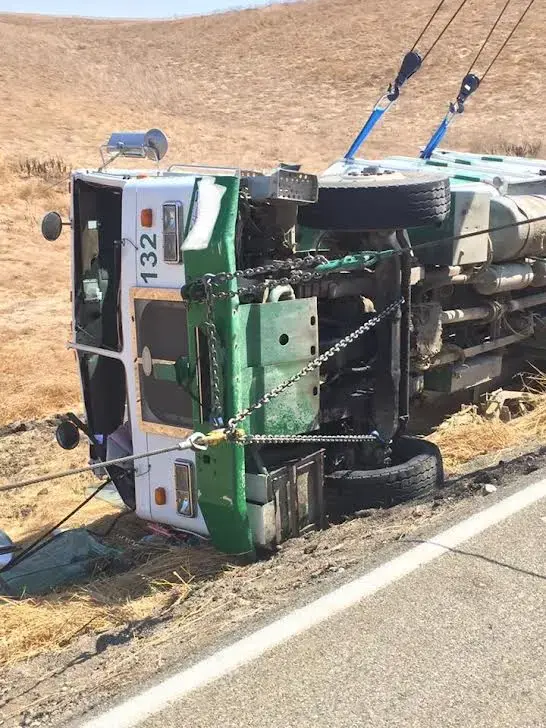
Full recovery is required when the vehicle is not just stuck but also unable to operate, overturned, jackknifed, or in a position where a straight-line winch pull would cause additional damage or create an unsafe condition. Recovery goes beyond towing — it often involves moving a vehicle that is stuck, overturned, or in a position where it simply cannot be rolled away. On the I-580 Altamont Pass grade, a jackknifed combination is a frequent scenario: the tractor is pointed one direction, the trailer another, and neither can be moved without first separating the combination, repositioning, and then recovering each piece individually. On I-5 near Patterson or Crows Landing, rollover calls on irrigation-adjacent off-ramps require uprighting before any tow can begin.
A recovery may also be triggered when an initial winch-out reveals hidden damage. A vehicle stuck in a ditch may need to be winched out first — and then the recovery reveals a bent suspension component, broken axle, or damaged tire that means the truck cannot drive even after it is back on solid ground. At that point, the call escalates from a winch-out to a full tow with possible heavy-recovery rigging. This is one of the most important reasons to give the dispatcher an accurate description of what happened, not just where the truck is.
The Equipment Roster: Why the Right Truck Has to Show Up First
One of the most consequential decisions in any big rig recovery call is whether the dispatched unit matches the actual job. Using a standard tow truck to pull a heavy-duty load is dangerous — it can cause the tow truck's front wheels to lift off the ground, leading to loss of steering and catastrophic secondary damage. This is not a hypothetical: gross vehicle weight ratings on recovery equipment exist precisely because the physics of extracting a 40-ton rig are completely different from extracting a disabled passenger car.
- Heavy wrecker: The workhorse for most big rig tows once the vehicle is in a towable position. Boom capacities range from 20-ton to 50-ton units for Class 8 applications, and heavy-duty units use multi-point winching systems to distribute weight and protect the frame during the pull.
- Rotator: Used when a standard wrecker cannot reach the rig at the required angle, when the vehicle is on its side or roof, or when confined space — like a tight interchange or a guardrail pinch point on I-680 — prevents a conventional approach. Rotator wreckers provide advanced recovery solutions with rotating booms for complex accident scenes, giving the operator full 360-degree reach without repositioning the recovery truck.
- Landoll trailer: The right tool when a big rig cannot be towed conventionally — no steering, locked axles, or frame damage that makes a wheel-lift or underlift unsafe. A Landoll trailer shifts its axle forward, lowering the back of the deck to the ground to create a built-in ramp for loading disabled or non-rolling equipment. When the truck cannot roll, cannot steer, or flat-out cannot be towed conventionally, this is the equipment that moves it safely.
- Air cushions / airbags: Used in rollover recovery to gently lift and upright a loaded trailer without creating a sudden load shift that could burst cargo through trailer walls. This is specialized equipment not present on every wrecker, which is why rollover calls often require a larger, more specialized crew.
- Side-puller / snatch block rigging: Used when the geometry of the scene prevents a straight-line pull — common on ditch recoveries along I-205 and I-5 where the angle between the stuck truck and the road shoulder does not allow a direct approach.
All Star Heavy Haul & Towing big rig towing service →
The information in this article is provided for general informational and educational purposes only. It is not a substitute for professional mechanical diagnosis, driver training, legal advice, or OEM service guidance. Readers are responsible for evaluating their own circumstances, following company policies, manufacturer recommendations, and all applicable laws and regulations. By using this information, readers acknowledge that All Star Heavy Haul & Towing is not responsible for decisions made based on this content or for any loss, damage, or interruption arising from reliance on it.
Why Recovery Takes Longer Than a Standard Tow — And Why That Is Normal
Drivers and dispatchers sometimes push for faster completion times, which is understandable — a stopped truck is lost revenue, and a partially blocking lane on I-5 or I-580 creates real risk for everyone. But understanding why heavy recovery takes the time it takes helps set appropriate expectations. Recoveries take longer than standard tows, especially with heavy equipment, because the conditions are usually unpredictable and require quick thinking and skill. Before any cable is connected on a legitimate heavy recovery, the crew is calculating load angle, assessing ground bearing capacity, identifying rated attachment points on the frame, positioning outriggers, and confirming that the pull vector will not create a secondary rollover or frame twist.
Modern heavy wreckers used on calls in the Tracy and Livermore corridor use load-sensing systems that allow the operator to monitor capacity in real time during the pull. The operator can see load capacities and view load sensing systems while keeping an eye on ratings placed on the equipment — so if a load shift occurs mid-pull, the system flags it before it becomes a problem. That technology makes recoveries safer and more predictable, but it does not make them instant.
What Dispatchers and Fleet Managers Should Tell the Recovery Crew
The single most effective thing a dispatcher can do to control recovery time and cost is give the responding crew accurate, complete information before they load up and leave the yard. Knowing whether you need a winch-out or a tow helps get the right equipment dispatched the first time. For a big rig call anywhere in the Tracy / Manteca / Livermore / Pleasanton / Patterson corridor, the most useful information to have ready includes:
- Exact location — mile marker, interchange name, direction of travel, and whether the truck is on the shoulder, in the median, or fully off-road.
- Rig configuration — tractor only, tractor with empty trailer, tractor with loaded trailer, and approximate loaded weight if known.
- Position of the vehicle — upright, leaning, on its side, or fully inverted.
- Mechanical condition — did the truck drive off the road, or did a mechanical failure cause the incident? Is the engine running? Can the truck be steered?
- Cargo type — hazmat, refrigerated, liquid bulk, dry van, flatbed, and open deck loads each affect how recovery is approached and sequenced.
- Access constraints — overhead clearances, soft ground surrounding the vehicle, guardrails, embankment slope, or proximity to live traffic lanes.
When a Winch-Out Becomes a Recovery Mid-Scene
One scenario that fleet managers should prepare for — particularly on the soft-shoulder runs along I-5 between Tracy and Crows Landing — is a call that starts as a winch-out and escalates to full recovery once the truck is back on pavement. It is common for a vehicle stuck in a ditch to require a winch-out, and then the recovery reveals hidden damage that makes driving impossible. At that point, the crew already on scene will assess whether their equipment can handle the secondary tow or whether a different unit needs to be dispatched. Communicating early with the responding team about any uncertainty regarding the truck's mechanical condition helps avoid a second trip to the same scene.
The Corridor Reality: I-5, I-580, and I-205 Recovery Conditions
The freight corridor connecting Tracy, Manteca, Livermore, Pleasanton, and Patterson presents specific recovery challenges that dispatchers in other regions may not account for. On Altamont Pass (I-580), grades, crosswinds, and narrow shoulder sections mean that a disabled big rig can be in a precarious position relative to live traffic faster than anywhere else on the corridor. On I-5 south of Tracy through Patterson Pass Road access points, agricultural field approaches create soft-ground exposure that does not exist on urban interstates. I-205, the Tracy bypass, sees heavy interchange traffic that compresses available working space when a recovery unit needs to position. These are not generic highway conditions — they are the specific terrain and traffic realities that determine which equipment rolls and how the recovery is sequenced from the moment the call comes in.