Disclaimer / Information Only Statement: The information in this article is provided for general informational and educational purposes only. It is not a substitute for professional mechanical diagnosis, driver training, legal advice, OEM service guidance, or a site-specific recovery plan. Readers are responsible for evaluating their own circumstances, following company policies, manufacturer recommendations, and all applicable laws and regulations. By using this information, readers acknowledge that All Star Heavy Haul & Towing is not responsible for decisions made based on this content or for any loss, damage, or interruption arising from reliance on it.
When a charter bus breaks down on Altamont Pass or a transit coach rolls off I-5 near Patterson, the recovery process looks nothing like towing a passenger car — or even a semi-truck. The weight, the body structure, the passenger-carrying mission, and the sheer length of the vehicle create a completely different set of challenges that demand purpose-built equipment and a disciplined decision process before the first hook is set. This guide walks fleet managers, dispatchers, and motor carrier safety directors through what professional bus and motorcoach recovery actually involves: the equipment on the scene, the sequence of decisions, and why certain situations require certain approaches. Understanding that process helps you make faster, smarter calls when a vehicle is down.
What Makes a Bus or Motorcoach Different to Recover
The first thing a recovery crew sizes up is the vehicle itself. According to the FMCSA, a motorcoach is specifically defined as a bus designed with an elevated passenger deck located over a baggage compartment — a configuration that fundamentally affects where and how recovery equipment can be attached. That elevated-floor and baggage-compartment configuration changes the underbody structure and can limit accessible, manufacturer-approved recovery attachment points. Unlike a conventional tractor, a motorcoach’s safe tow and recovery points vary by manufacturer, model, suspension design, and the type of damage involved. Weight is the other critical variable. Full-size motorcoaches carry curb weights between 35,000 and 45,000 pounds and can reach GVWRs of 44,000 to 50,000 pounds when fully loaded with passengers and luggage. Transit and motor coaches often push axle weight limits even when they appear lightly loaded, because ADA equipment, emission systems, and safety hardware have steadily increased tare weights over the decades. Full-size motorcoaches commonly have high curb weights and GVWRs that may place them in the heaviest commercial-vehicle classes. Actual weight varies by manufacturer, seating configuration, baggage, fuel, accessibility equipment, passenger load, and applicable axle limits. That size and weight make coach recovery a heavy-duty operation even though the vehicle’s structure and approved attachment points differ substantially from a tractor-trailer.
The Three Equipment Categories That Show Up on a Bus Call
Professional motorcoach recovery typically involves one or more of three heavy-duty tool categories, selected based on what the bus is doing and where it is. The wrong equipment choice can cause structural damage to a vehicle that costs several hundred thousand dollars to replace.
- Heavy-duty wrecker with underlift: The workhorse for upright, accessible bus breakdowns on a clear shoulder. Heavy-duty wreckers are designed and built to handle large commercial vehicles such as tractor-trailers, buses, motorhomes, and commercial trucks. The underlift is configured at approved towing or axle-support locations based on the coach design, manufacturer guidance, and the damage assessment. Proper attachment selection is essential because an improper lift point can damage body structure, suspension components, steering, or drivetrain systems. For an upright, accessible coach with suitable towing points and rolling axles, a heavy-duty wrecker may be an appropriate transport option.
- Rotator wrecker: When access is restricted, when the bus has left the travel lanes at a severe angle, or when a standard lift approach would stress the coach body, a rotator becomes the preferred tool. A rotator features a boom that rotates 360 degrees, allowing operators to lift, recover, and reposition heavy vehicles from almost any angle — a capability that can allow the crew to work from a safer or more workable position when direct access behind the coach is limited. On the narrow shoulders of Altamont Pass or the embankments along Patterson Pass Road, where there may be no room to position a standard wrecker directly behind the coach, the rotator’s side-reach capability may be necessary to create a workable recovery angle.
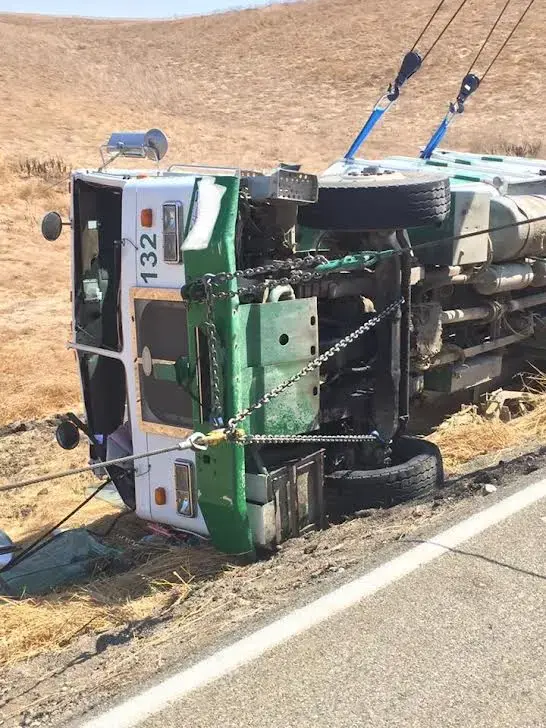
- **Air-cushion recovery system: When a coach is on its side, air-cushion recovery may be used as part of a rollover plan. Large air cushions are positioned and inflated in controlled stages to assist in lifting and righting the vehicle. Depending on the coach position, cargo, terrain, structural condition, and scene access, this method may be used alongside rotators, winch trucks, or other recovery equipment. Any coach involved in a rollover should receive qualified inspection and repair evaluation before it returns to passenger service.
How the Recovery Decision Gets Made at the Scene
Experienced heavy-recovery operators follow a scene-assessment sequence before any rigging goes on a bus. The variables they evaluate determine which equipment combination is dispatched — and in what order. Is the vehicle upright? An upright, stationary bus with a clear shoulder behind it is a different job from a coach that has gone into the ditch nose-first or rolled on an embankment. Upright calls most often resolve with a heavy wrecker and underlift. Vehicles that are on their side or partially off the roadway surface require a rotator, airbag systems, or both working in tandem. What is the terrain and access situation? The grades and narrow shoulders on Altamont Pass (I-580 between Livermore and Tracy) are not the same working environment as the flat, open shoulders on I-5 near Crows Landing. A tight-shoulder, steep-grade scenario changes which boom angles are physically achievable and whether outriggers can be set safely. Where are the safe attachment points? Buses do not have universal tow hooks. The frame architecture under an elevated-floor motorcoach, the low-floor transit bus, and a school bus all differ significantly. Recovery operators should identify manufacturer-designated towing points, suitable structural attachment locations, or axle-support locations before rigging, based on available OEM information and the condition of the coach. Is there cargo or passenger weight involved? Passenger status and baggage-bay contents must be accounted for before recovery begins. Passengers should be managed in accordance with the carrier’s emergency procedures and the direction of law enforcement or emergency personnel when they are on scene. The crew accounts for this in their rigging plan.
Winch-Out vs. Full Recovery: What the Difference Means for a Bus
Dispatchers sometimes ask whether a bus situation is a "winch-out" or a "full recovery" — and the distinction matters for how quickly the vehicle can return to service and what the recovery timeline looks like. A winch-out applies when the coach is still on its wheels but has left the pavement — pulled off the shoulder too far on a soft berm, drifted into soft dirt at a rest area, or eased into shallow drainage off I-5. The vehicle appears upright and may be capable of returning to a stable surface, subject to an on-scene damage and stability assessment. Depending on access, ground conditions, vehicle condition, load, and traffic control, a straightforward winch-out may require less time and equipment than a full recovery. Full recovery is the correct term when the coach is not in a towable condition as it sits — it is overturned, severely off-grade, partially submerged, or in a position where it must be righted, repositioned, and stabilized before it can be hooked for transport. Full recovery for a bus typically requires a rotator as the primary tool, often with airbag systems or additional winch trucks working as secondary rigging. The operation is methodical: the recovery crew establishes an anchor plan, sets outriggers, rigs the coach at safe attachment points, and executes the lift or roll in controlled stages. It can require more time, equipment, traffic control, and coordination, but it is intended to stabilize and reposition the coach before transport can be considered.
All Star's bus and motorcoach towing service →
Why Bus Recovery on the I-580 / I-5 / I-205 Corridor Is a Specialty Call
The freight and passenger corridor connecting Livermore, Tracy, Manteca, and Patterson sees a significant mix of charter coaches, transit buses, and tour operators using I-580 through Altamont Pass, I-205 as the Tracy bypass, and I-5 down through the valley toward Crows Landing. These routes present specific operational challenges that make specialized recovery capability — not general towing — the right call. Altamont Pass on I-580 includes sustained grades, crosswinds, changing road geometry, narrow shoulder sections, and heavy freight traffic. A rotator positioned correctly on that grade can work at angles a conventional wrecker cannot, and its outrigger system provides the stability that a sloped shoulder undermines. I-5 between Tracy and Patterson, by contrast, offers wider shoulders but involves distances where response time becomes the critical variable — a coach with no propulsion during extreme Central Valley heat can quickly become a passenger-safety concern, particularly if air conditioning, ventilation, or access to water is affected. Dispatchers coordinating from outside the region should know that Tracy sits at the junction of I-580, I-205, and I-5, making Tracy a strategically located area for heavy-recovery equipment serving this corridor. All Star Heavy Haul & Towing operates out of Tracy and Manteca yards with heavy recovery equipment positioned for exactly these calls.
What Fleet Managers and Dispatchers Should Communicate When They Call
The faster a recovery crew can be briefed, the faster the right equipment rolls. When a motorcoach is down on one of these routes, the information that matters most: - Exact milepost and direction of travel — not just the highway number - Vehicle position — upright on the shoulder, partially in the lane, nose-down in a ditch, or on its side - Approximate coach length and type — 40-foot transit, 45-foot over-the-road motorcoach, articulated bus - Whether luggage bays are loaded — affects the weight and rigging plan - Number of passengers still on board or nearby — affects scene safety coordination - **Any known damage — contact with a guardrail, barrier, ditch, or other object may affect potential attachment points and recovery planning. For fleet accounts and motor carrier operators who run coaches regularly through this corridor, establishing a pre-incident relationship with a recovery provider — including having your vehicle specifications on file — can help reduce avoidable information-gathering delays when a call comes in during off-hours or in a remote section of the corridor.
After the Recovery: Getting the Coach Transported
Once a bus is righted and stabilized, the next step is determining the appropriate transport method. Whether a coach can move under its own power should be determined by the carrier, qualified maintenance personnel, and applicable company and manufacturer procedures—not solely by the recovery crew. If the coach is not suitable for self-propelled movement, transport options may include towing behind a properly configured heavy wrecker or loading onto a Landoll trailer when undercarriage, suspension, steering, drivetrain, or structural damage makes conventional towing unsuitable. A commercial fleet operator coordinating a multi-vehicle incident may benefit from a provider capable of coordinating both the recovery and transport portions of the response
For charter companies, tour operators, transit fleets, motorcoach carriers, construction companies, dump-truck operators, and commercial fleets operating through Tracy, Manteca, Livermore, Pleasanton, Patterson, Stockton, Modesto, and the I-580/I-205/I-5 corridor, All Star Heavy Haul & Towing provides 24/7 dispatch for heavy-duty towing and recovery. In addition to bus and motorcoach recovery, All Star responds to semi-truck and tractor-trailer breakdowns, trailer-only moves, combination splits, dump trucks, specialty commercial trucks, loaded trailers, heavy equipment, winch-outs, rollovers, and other heavy-recovery incidents. Equipment selection and recovery planning depend on vehicle configuration, load, cargo condition, terrain, traffic conditions, access, and the circumstances of the incident. Learn more about commercial fleet towing accounts, or call (209)-833-7107 for your towing or recovery needs.