Disclaimer / Information Only Statement: The information in this article is provided for general informational and educational purposes only. It is not a substitute for professional mechanical diagnosis, driver training, legal advice, or OEM service guidance. Readers are responsible for evaluating their own circumstances, following company policies, manufacturer recommendations, and all applicable laws and regulations. By using this information, readers acknowledge that All Star Heavy Haul & Towing is not responsible for decisions made based on this content or for any loss, damage, or interruption arising from reliance on it.
A motorcoach breakdown on I-580 climbing Altamont Pass or on I-5 south of Tracy is never a minor inconvenience — it is a passenger-safety event. The decision that matters most in those first few minutes is not how to fix the problem; it is whether the coach is safe to move at all. Too many operators lose thousands of dollars in secondary damage — and worse, put passengers at risk — because a driver tried to nurse a seriously compromised coach to the next exit instead of calling a professional wrecker immediately. This guide covers the key warning signs across three critical systems — brakes, air suspension, and transmission — that indicate your motorcoach needs a heavy-duty wrecker on scene, not a cautious limp-in.
Why the Limp-In Gamble Is Costlier for Buses Than for Trucks
Motorcoaches carry passengers, which creates a fundamentally different risk profile than a loaded semi. Federal safety thresholds for passenger-carrying vehicles are more stringent than for freight vehicles:That is not correct for a typical full-size motorcoach. Under 49 CFR § 393.52, the exact brake-performance percentage depends on vehicle category, chassis, seating capacity, and GVWR. Full-size passenger coaches are generally in the “all other passenger-carrying vehicles” category, which uses the 43.5% service-brake standard—not the 52.8% standard. Many larger freight vehicles are also subject to 43.5%, so the comparison should not be used as a bus-versus-truck distinction. That means a brake system that might technically allow a cargo truck to continue moving could already represent an out-of-service condition on a fully loaded coach. Beyond compliance, the mechanical reality is that continuing to operate a coach with a compromised brake, suspension, or transmission system rarely results in a minor repair at the next service stop — it almost always results in a larger failure, a longer delay, and a much higher repair bill.
Brake Warning Signs That Mean Stop the Coach Now
Brake defects are among the most serious conditions found during commercial-vehicle inspections because they can affect stopping performance, directional stability, and passenger safety. Federal regulations under FMCSA 49 CFR 393 are unambiguous: Federal brake regulations require commercial motor vehicles to meet applicable brake-performance standards, and certain brake defects can place a coach out of service until repairs are made. Whether a vehicle is placed out of service depends on the specific condition, the applicable inspection criteria, and an authorized inspector’s determination. Drivers and operators should treat any of the following as a hard stop — do not continue moving until a qualified technician or a heavy-duty wrecker has evaluated the situation:
- Vehicle pulling to one side under braking. A coach that tracks left or right when you press the brake pedal signals unequal braking force — potentially a seized caliper on one side. A seized caliper can progress to wheel lockup and loss of directional control.
- Burning smell or visible smoke from a wheel well. A burning odor or smoke from the wheel area is a classic indicator of an overheated brake from a seized caliper — an automatic out-of-service violation under FMCSA criteria.
- Soft, spongy, or low brake pedal. Master cylinder leakage, a soft pedal, or inability to generate brake pressure is explicitly identified as an out-of-service condition under FMCSA regulations. Do not attempt to continue operating.
- ABS warning light combined with wheel skid behavior. An ABS malfunction that results in reduced braking capability or inability to prevent wheel lockup may constitute an out-of-service condition depending on the vehicle's model year. When the ABS light illuminates alongside any unusual brake response, stop and call for help.
- Any audible air leak from the brake circuit. Air brake systems rely on sustained pressure. A single air leak can gradually reduce braking force, and moisture in air lines can block airflow entirely under certain conditions. An audible air leak detected at a brake chamber is an automatic out-of-service violation.
Air Suspension Warning Signs That Change Your Coach's Geometry
Most modern motorcoaches ride on electronically controlled air suspension systems. When that system begins to fail, the consequences go far beyond a rough ride — ride height, handling, tire loading, and vehicle stability can be affected as the coach moves. That is a compounding safety risk, especially on grades like Altamont Pass on I-580 or the rolling terrain along I-5 near Patterson.
- Visible sagging or uneven ride height. If one side or corner of the coach is riding noticeably lower than the others, that is a strong indicator of a leaking air spring or a failed sensor. Air bags can develop leaks from punctures, dry rot, or age — and when they fail, the coach cannot maintain proper ride height.
- Hissing sounds from beneath the coach. A hissing sound from lines, valves, or air bags signals active air loss. Even small leaks compound quickly under load and can cause a compressor to run continuously in a failed attempt to maintain pressure.
- Compressor running constantly or not at all. When the air compressor overworks due to a leak or pressure loss, it can fail prematurely — leading to complete suspension failure. A compressor that runs without stopping or that fails to build pressure is a system warning that demands immediate professional attention.
- Suspension warning light on the dash. Electronically controlled air suspension problems — including wiring corrosion, loose connectors, and sensor failures — typically first appear as a dash warning light, sometimes accompanied by inconsistent ride height adjustments.
- Coach leaning or rolling in turns. A coach that leans excessively through a curve, squats under acceleration, or rolls when braking indicates worn or compromised suspension components. These handling characteristics can affect the driver’s ability to maintain control, particularly at highway speeds, in high winds, or on grades.
Transmission Warning Signs: When Altamont Pass Reveals a Hidden Problem
Motorcoach transmissions — whether Allison, Voith, or ZF units — are engineered for demanding duty cycles, but they are not indestructible. The sustained grades of Altamont Pass on I-580, the stop-and-go approach to the I-205 interchange in Tracy, and long hauls down I-5 through Patterson all put real thermal stress on automatic transmission systems. Recognizing early heat-related symptoms can be the difference between a service call and a full transmission rebuild. Transmission overheating does not always trigger a dashboard warning immediately — which is exactly why physical and sensory cues matter:
- Burnt or acrid odor from the transmission. A sharp, burnt smell — especially one that intensifies after climbing a grade — is one of the most recognizable early signs of overheated transmission fluid. Overheated fluid loses its lubricating and hydraulic properties rapidly, accelerating internal component wear.
- Delayed, hesitant, or harsh gear changes. If the coach hesitates before shifting, shifts later than normal, or if shifts feel abrupt or clunky, elevated transmission temperature may be affecting hydraulic fluid performance. These are early-stage symptoms that worsen quickly under continued load.
- Transmission slipping — engine revving without corresponding speed. Slipping indicates the clutch packs have lost friction efficiency, often as a direct result of overheating. Continuing to operate with a slipping transmission causes rapid internal damage.
- Transmission entering limp mode (locked into a single gear). When thermal protection logic locks the transmission into a single gear — usually second or third — the system is actively protecting itself from catastrophic failure. A coach in limp mode may have reduced performance and may not be able to maintain safe speed or respond predictably on grades. The driver should follow company emergency procedures, assess the immediate safety of the location, and obtain qualified mechanical guidance. If continued movement is not clearly safe, stop at the first safe location, arrange passenger assistance as appropriate, and request heavy-duty recovery.
- Whining, grinding, or buzzing sounds from the transmission. Unusual noises often accompany fluid aeration or metal-on-metal contact caused by a breakdown of lubricating films. These sounds indicate that internal damage may already be progressing.
- **If qualified maintenance personnel identify dark, burnt-smelling, or metallic-contaminated transmission fluid during inspection, the coach should receive prompt professional evaluation before returning to service. Dark, discolored, or metallic-sheen transmission fluid (visible at inspection). Fluid with a burnt odor, dark color, or metallic sheen indicates overheating or clutch material breakdown — a condition that warrants immediate professional evaluation, not a continued run to the next yard.
The Decision Framework: Stop Now vs. Next Safe Exit
Not every warning sign demands an immediate roadside stop — but the threshold for a motorcoach is much lower than for an unloaded freight vehicle. Use the following framework to make a rapid, defensible decision: Stop the coach immediately and call for a wrecker if you observe: - Any brake-side smoke, burning smell from a wheel well, or hard pull under braking - A soft or low brake pedal - Any audible air leak from the brake system - Transmission slipping with loss of drive, or confirmed limp mode with grades ahead - A visible air suspension collapse on one corner of the coach **Move to the next safe exit or pull-off — cautiously, at reduced speed. An air suspension dash warning light without visible sag or handling change - Harsh shifts that appeared suddenly but braking remains normal When in doubt, the answer is always to stop. Secondary mechanical damage from a limp-in almost always costs more than a wrecker call. And on a coach with passengers aboard, the liability calculus is unambiguous.
All Star Heavy Haul & Towing bus and motorcoach towing →
What a Heavy-Duty Motorcoach Wrecker Response Looks Like
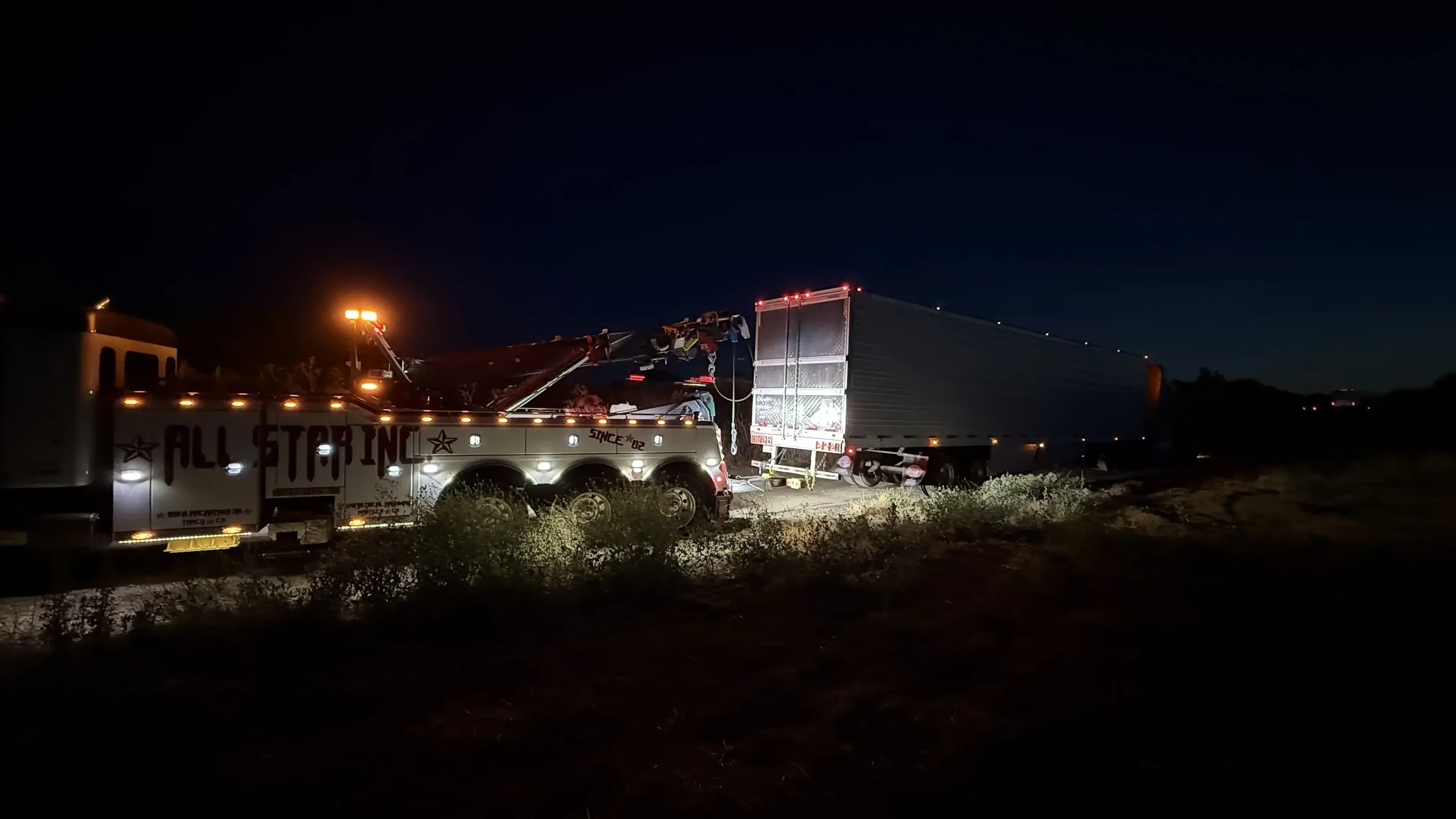
Dispatching the wrong equipment to a motorcoach breakdown is a secondary problem in itself. A standard light-duty or medium-duty tow truck is not rated for a full-size coach, and an improper hitch or lift point can cause structural damage to the vehicle and create additional liability. All Star Heavy Haul & Towing operates heavy wreckers, rotators, and airbag trailers specifically suited for passenger-vehicle recovery calls throughout the Tracy, Manteca, Livermore, Pleasanton, and Patterson corridor. That means whether a coach has gone down on I-580 climbing Altamont Pass, stalled on I-205 near the Tracy interchange, or broken down on I-5 approaching Crows Landing. Dispatch evaluates available equipment and the scene information provided to determine the appropriate response unit for the call. Fleet managers and dispatchers coordinating charter or transit operations through this corridor can establish a commercial account to streamline future incident response. Visit our commercial fleet towing page to learn how priority dispatch and account billing work for bus and motorcoach operators. For drivers or operators currently dealing with a breakdown near Tracy, CA or anywhere along the I-5, I-205, I-580, or I-680 corridors, contact dispatch directly — 24 hours a day, seven days a week.
For charter companies, transit operators, tour-coach fleets, and passenger carriers operating through Tracy, Manteca, Livermore, Pleasanton, Patterson, Stockton, Modesto and the I-5/I-205/I-580 corridor, All Star Heavy Haul & Towing provides 24/7 dispatch for heavy-duty towing and motorcoach recovery. Equipment selection and recovery planning depend on coach configuration, passenger status, access, traffic conditions, terrain, and the circumstances at the scene. Visit our commercial fleet towing page to discuss account options, or contact dispatch at (209)-833-7107 for an active breakdown.