This article is for general educational purposes only and does not constitute professional mechanical, safety, or diagnostic advice. Do not rely on this content as the sole basis for vehicle operation decisions. All Star Heavy Haul & Towing, Inc. expressly disclaims all liability for damages, injuries, or losses arising from reliance on this information. Readers assume all risk for their vehicle operation and maintenance decisions. Always consult qualified technicians and comply with FMCSA regulations.
The stretch of I-580 climbing Altamont Pass between Livermore and Tracy is one of the most demanding grades in California's Central Valley freight corridor. Add a fully loaded trailer on a warm afternoon, and your 18-wheeler's air brake system is already working at its limit before you reach the summit. Most drivers know something is wrong when they hear it or feel it—but knowing what it means, and whether to pull over now or limp to the next exit, can be the difference between a managed recovery and a catastrophic loss of braking power. This guide covers the specific air brake warning signs that demand an immediate stop and a call for professional 18-wheeler towing service—not a roadside attempt to keep moving.
Why Air Brake Failures Deserve Serious Attention
Air brake systems are the primary safety architecture on every modern 18-wheeler. Unlike the hydraulic brakes on a passenger car, your rig's system relies on compressed air stored in tanks, routed through lines, and converted into mechanical stopping force at each axle. When one component in that chain degrades, the entire system is compromised.
Warning Sign #1: The Low-Air Pressure Light or Buzzer Activates
Federal regulations under 49 CFR § 393.51 require every commercial motor vehicle equipped with air brakes to have a warning signal—audible, visible, or both—that activates continuously when air pressure in the service reservoir system drops to 60 PSI or below. This is not an advisory notice. When that light illuminates or that buzzer sounds while you are moving, your system does not have enough pressure to sustain reliable braking. A low-pressure warning can mean the air compressor has stopped building pressure, there is a significant leak in the lines or tanks, or a valve has failed. None of these conditions resolve themselves at highway speed. Pulling over on the nearest safe shoulder—whether you are on I-205 near Tracy or I-680 approaching Pleasanton—and calling for a professional wrecker is the correct response.
Warning Sign #2: A Persistent Hissing Sound From the Brake System
A healthy air brake system is quiet. An audible hissing sound—especially one that continues after you release the pedal or when the truck is stationary—is one of the clearest indicators that air is escaping from somewhere it should not be. Common leak points include brake chambers, line fittings, hoses, and tank seals. Even a small leak that seems manageable at first can drain system pressure faster than the compressor can recover, particularly on grades where the brakes are working harder. A leak that lets you roll away from a truck stop in Tracy may become a crisis by the time you reach the top of Patterson Pass Road.
Warning Sign #3: Noticeably Longer Stopping Distances
If your rig is taking longer than expected to slow down after brake application, something in the pneumatic or mechanical chain is underperforming. Slower stopping response—particularly under heavy loads or during emergency braking—can point to low air pressure, contamination inside the brake chambers, or a slack adjuster that is out of specification. A truck that needs more distance to stop than it did yesterday is a truck that has already lost a margin of safety. On the I-5 corridor between Manteca and Crows Landing, where merge distances are tight and freight traffic is dense, that reduced margin is not recoverable by driving more carefully. It requires a technician.
Warning Sign #4: The Truck Pulls to One Side Under Braking
Consistent lateral pull during brake application is a sign that braking force is not being applied equally across the axles. This can result from unequal air pressure between circuits, a faulty chamber on one side, or brake imbalance caused by mismatched components. At highway speed on a wide interstate, a pull feels manageable. In a hard stop or on a wet section of Highway 132, that imbalance can cause a trailer to push sideways into an uncontrolled jackknife. Brake-related pulling should be treated as a do-not-operate condition until a qualified technician has inspected the system.
Warning Sign #5: Grinding, Squealing, or Rhythmic Thumping During Brake Application
Unusual noises during braking—squealing, scraping, or a rhythmic thumping that corresponds to wheel rotation—indicate mechanical problems inside the brake assembly. Squealing or grinding typically points to worn brake shoes or damaged brake drums where metal-to-metal contact is occurring. A rhythmic thump can signal a cracked drum. These sounds mean friction material is compromised. The longer a drum or shoe continues to operate in this condition, the more heat it generates and the higher the risk of complete brake fade, where overheated components lose the ability to create stopping friction. Brake fade is especially dangerous on descending grades like the westbound I-580 drop from Altamont Pass toward Livermore.
Warning Sign #6: Excessive Air Compressor Cycling or a Soft, Spongy Pedal
If you notice the air compressor running constantly—or the system is taking longer than normal to build pressure after startup—that pattern indicates the system is struggling to maintain pressure, often because air is escaping somewhere. Similarly, a brake pedal that feels unusually soft or spongy underfoot is a symptom of air leakage reducing the system's pressure and stopping power. Both conditions are progressive: they tend to worsen under load, in heat, or during repeated brake applications. An 18-wheeler that cannot sustain normal system pressure needs to be evaluated by a professional before it continues on any freight run.
The Altamont Pass and I-5 Corridor Context: Why These Signs Are More Urgent Here
The grades and traffic density of the Tracy / Manteca / Livermore / Patterson corridor amplify the consequences of every air brake symptom listed above. Westbound I-580 descending Altamont Pass puts sustained demand on trailer brakes over several miles. I-5 between Tracy and Patterson offers limited safe shoulder space in sections, and I-205 through Tracy moves heavy freight volume at highway speeds with minimal reaction time. When any of these warning signs appear in this corridor, the risk calculus is straightforward: a brief, managed stop to call for a heavy-duty wrecker is far less costly than the alternative. The freight is insured. The trailer can be recovered. The load can be transferred. The outcomes of a brake failure at 65 mph are not manageable after the fact.
professional 18-wheeler towing and recovery →
What Happens After the Call: Professional Recovery on the I-580 / I-5 / I-205 Corridor
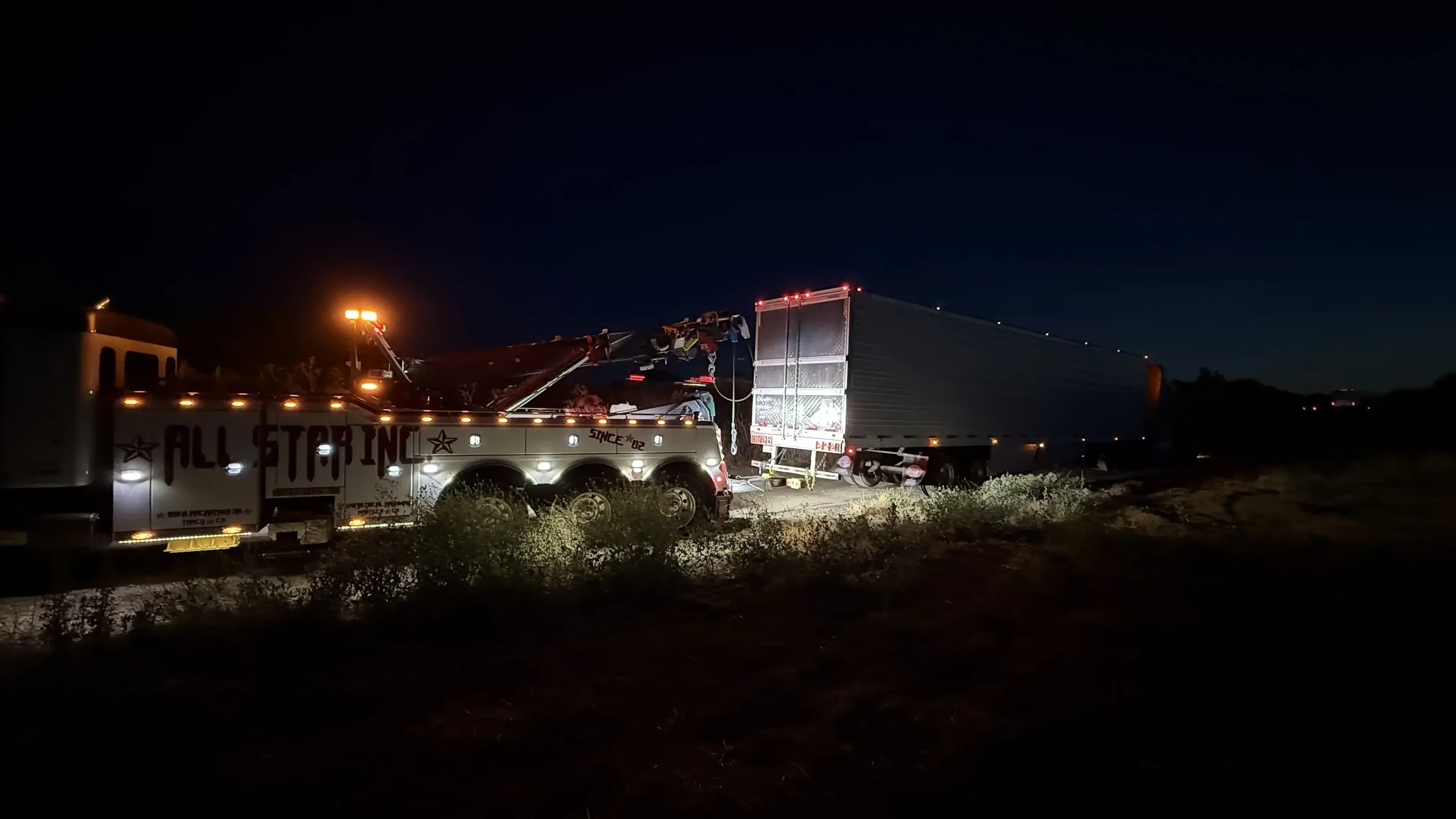
When a driver calls for wrecker service on an 18-wheeler with active brake problems, the recovery team's first job is to move the unit safely without relying on a brake system that may be partially or fully compromised. Professional recovery teams typically use heavy-duty equipment—rotators, heavy wreckers, and Landolls—operated by trained personnel who understand how to manage a loaded combination vehicle with an unknown brake state. The unit is transported to a repair facility where technicians can perform a complete air system inspection: checking compressor output, testing pressure loss rates against FMCSA standards, inspecting chambers, drums, shoes, and slack adjusters, and identifying the specific failure point before the truck returns to service. Skipping that step and attempting a roadside patch creates liability exposure and puts the driver back in a cab with an unresolved safety condition.
For 24/7 professional heavy-duty towing and recovery in the Central Valley corridor, contact All Star Heavy Haul & Towing at 209-833-7107.
By reading this article, you acknowledge that All Star Heavy Haul & Towing, Inc., its officers, employees, and agents make no representations or warranties regarding the accuracy, completeness, or applicability of this information. Circumstances vary by vehicle, load, conditions, and maintenance history. This content is not a substitute for professional inspection, diagnosis, or repair by certified mechanics.